
Liquid cooling is increasingly important for high-density AI
GPU and HPC workloads can drive rack densities beyond what conventional air-cooling layouts were designed to handle efficiently. Direct-to-chip closed-loop liquid cooling is therefore the current preferred design principle for Blue Danube. Dry/free-cooling potential, higher return temperatures and low water demand are intended to be optimized around the final site and hardware.
Resilient power is part of the sustainability architecture
The current Blue Danube design logic combines grid-first supply with BESS/UPS and an island-capable microgrid concept. Green-hydrogen fuel cells are reserved as a site-specific long-duration fossil-free backup design option, subject to detailed engineering, safety, fuel availability, permitting and economics.
PUE, WUE and heat reuse need transparent measurement
EU Delegated Regulation 2024/1364 establishes sustainability reporting for covered data centers and includes metrics for energy, water, renewable energy and reused waste heat. It explicitly defines indicators including PUE, WUE, ERF and REF.
The Blue Danube concept treats these metrics as design and later operating KPIs. A working PUE target may guide engineering, but it is not presented as a guarantee before a site, climate assumptions and operating profile are known.
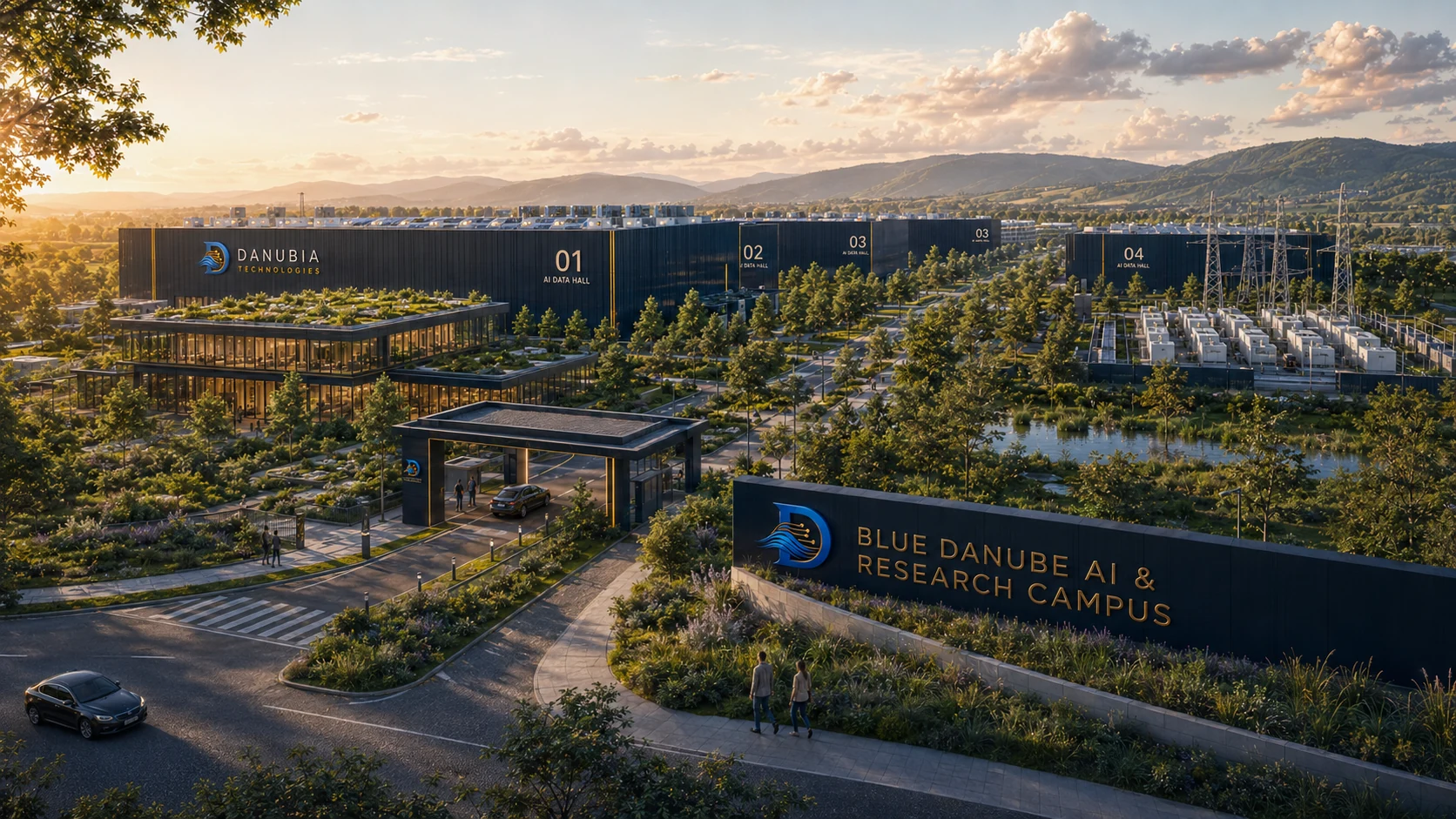
Nature integration has to coexist with security and resilience
- Brownfield-aware and land-efficient site planning.
- Shade, native planting, biodiversity corridors and stormwater retention where compatible with site security.
- Heat-reuse interfaces designed early, but only promised where an off-taker and viable business case exist.
- Water consumption remains a KPI; treated rainwater/process water may be used as cooling make-up where water quality and site engineering permit.
- Climate resilience for heat, heavy rain and long-term operational robustness.
Selected public sources
- EUR-Lex – Delegated Regulation (EU) 2024/1364
- IEA – Austria 2026 Energy Policy Review
- Land Niederösterreich – Rechenzentren-Strategie 2026
Public sources are used as market and regulatory context. Project-specific site, grid, permitting and commercial conclusions require dedicated due diligence.